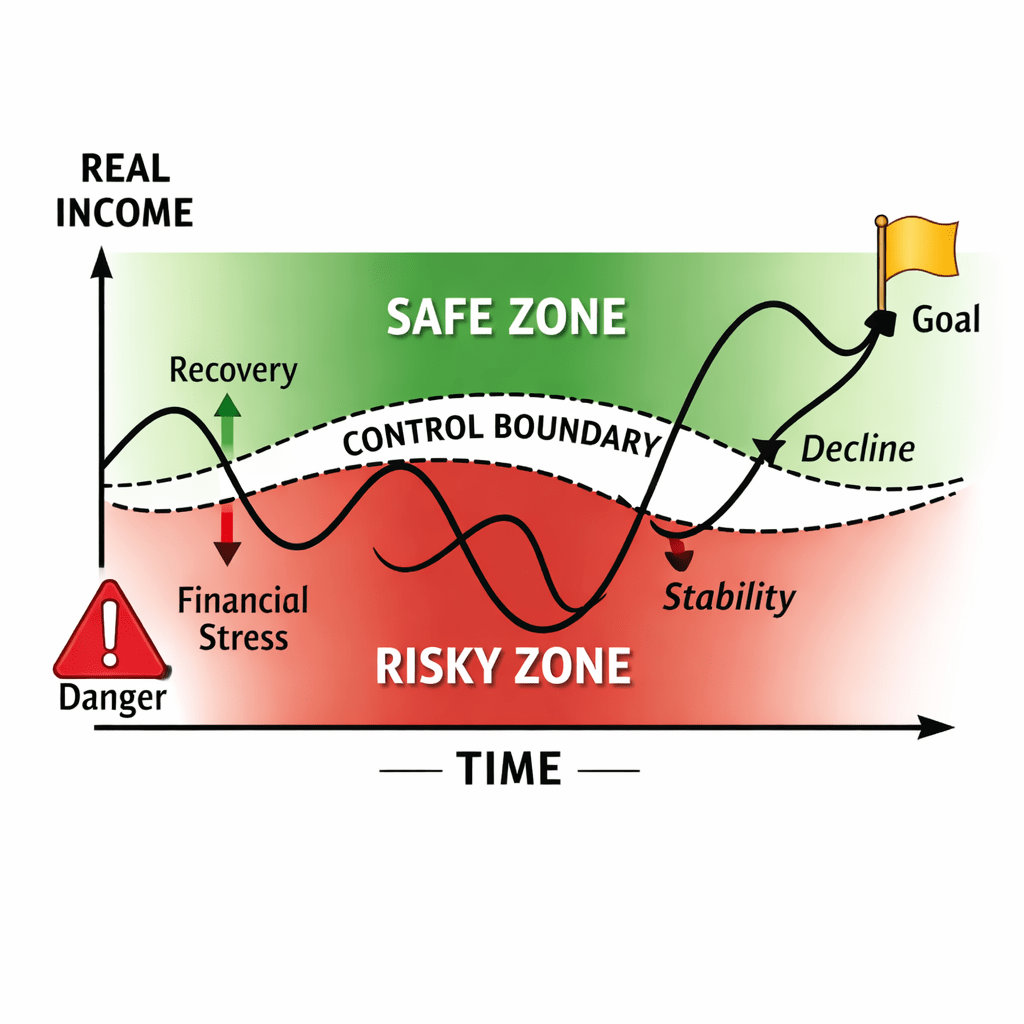
Financial pressure does not always originate from a lack of income.
It frequently originates from a misinterpretation of that income.
Two concepts are commonly used to evaluate financial position: cash flow and income. Both appear logical. Both appear sufficient. Neither, on its own, defines what is actually available for use.
This distinction is not semantic. It is structural.
Understanding the difference between cash flow and real income determines whether financial decisions are made with accuracy or distortion.
What Cash Flow Actually Represents
Cash flow is the movement of money over time.
It measures the rate and timing of inflows and outflows:
- Salary deposits
- Business revenue
- Transfers
- Rent or mortgage payments
- Utilities
- Subscriptions
- Variable spending
Cash flow answers a single question:
How much money is entering and leaving?
This makes it useful for observing activity. It provides visibility into motion. It reflects direction.
However, movement does not define control.
Why Cash Flow Feels Sufficient (But Isn’t)
Cash flow creates a perception of clarity because it is visible.
Money enters an account. Transactions occur. Balances change.
This creates an intuitive conclusion:
If money is flowing, the system is functioning.
The issue is that cash flow does not distinguish between:
- committed money
- restricted money
- discretionary money
All inflows are visually identical, but functionally different.
Without separation, financial interpretation becomes inaccurate.
The Core Limitation of Cash Flow
Cash flow measures activity, not usability.
It shows what is happening, but not what is available.
This leads to a consistent structural error:
Money that appears accessible is assumed to be usable, even when it is already allocated.
This gap between appearance and reality produces financial pressure, even when income is stable.
The Psychological Layer: Why the Error Persists
This misinterpretation is reinforced by cognitive behavior.
When money enters an account, it is often mentally categorized as available.
This is not a deliberate calculation. It is a cognitive shortcut.
Behavioral finance refers to this as mental accounting.
Mental accounting assigns perceived value based on appearance rather than constraint.
As a result:
- inflow is mistaken for availability
- balance is mistaken for capacity
- activity is mistaken for control
The outcome is consistent: decisions are made using distorted inputs.
Defining Real Income
Real income is not total income.
It is not gross income.
It is not even net income in the conventional sense.
Real income is defined as:
The portion of total inflow that remains after all fixed, non-discretionary obligations have been removed and is actually available for use.
What Real Income Removes
To isolate real income, the following must be accounted for:
- housing costs (rent or mortgage)
- utilities
- insurance
- debt obligations
- recurring essential expenses
These are not optional. They are committed.
Once removed, what remains is the only portion that can be used for:
- discretionary spending
- saving
- investing
- allocation decisions
This remainder is real income.
Cash Flow vs Real Income: Structural Difference
Cash flow and real income serve different functions.
Cash flow tracks movement.
Real income defines control.
Cash flow is dynamic and time-dependent.
Real income is static within a given period and decision-focused.
Why Positive Cash Flow Can Still Create Pressure
It is entirely possible to maintain positive cash flow while experiencing financial strain.
Example:
Income: 5,000
Expenses: 4,600
Cash flow: +400
This appears stable.
However, the actual usable amount is limited to 400.
All other funds are committed.
If decisions are made based on total inflow rather than usable income, the result is:
- overestimation of capacity
- inconsistent spending
- recurring shortfalls
The issue is not insufficient income. It is incorrect measurement.
The Role of Timing in Cash Flow Distortion
Cash flow is influenced by timing.
Income may arrive:
- bi-weekly
- monthly
- irregularly
Expenses, however, are fixed and scheduled.
This creates periods where:
- balances appear elevated
- obligations have not yet been applied
This leads to temporary overconfidence in available funds.
Once obligations are executed, the discrepancy becomes visible.
Real income eliminates this distortion by focusing only on what remains after obligations, independent of timing.
Why Gross Income Is an Unreliable Reference
Gross income represents total inflow before deductions.
It does not account for:
- taxes
- fixed expenses
- required payments
Using gross income as a reference point introduces immediate error.
It inflates perceived capacity and creates unrealistic expectations.
Financial decisions made from gross figures are structurally flawed from the outset.
The Measurement Problem in Personal Finance
Most financial systems fail at the point of measurement.
Tracking, budgeting, and optimization assume that the base number is correct.
If the base number is inaccurate, all subsequent decisions are affected.
This leads to:
- excessive restriction
- inconsistent adherence
- perceived lack of progress
The issue is not discipline. It is input quality.
Real Income as the Correct Measurement
Real income corrects the measurement problem.
It establishes a clear boundary between:
- committed capital
- controllable capital
This allows for decisions to be made with precision.
Once real income is defined:
- spending aligns with capacity
- planning becomes accurate
- variability is reduced
Practical Comparison
Scenario A:
Income: 4,500
Fixed expenses: 4,000
Real income: 500
Scenario B:
Income: 3,200
Fixed expenses: 2,200
Real income: 1,000
Scenario B has lower income but higher real income.
Control is determined by usable capital, not total inflow.
Why This Distinction Changes Decision-Making
When decisions are based on real income:
- spending becomes intentional
- saving becomes consistent
- planning becomes sustainable
When decisions are based on cash flow or gross income:
- spending becomes reactive
- saving becomes inconsistent
- planning becomes unreliable
The difference is not behavioral. It is structural.
The Relationship Between Real Income and Financial Control
Financial control is not determined by how much is earned.
It is determined by how much is controllable.
Real income defines this boundary.
Without it, control is assumed rather than calculated.
With it, control becomes measurable and actionable.
Why Budgeting Alone Does Not Resolve the Issue
Budgeting organizes spending within categories.
It does not redefine the base number.
If the underlying income figure is inaccurate, budgeting becomes restrictive rather than effective.
Real income must be established before budgeting can function correctly.
Transitioning from Cash Flow to Real Income
The transition requires a simple but precise process:
- Identify total inflow
- Subtract all fixed, non-discretionary obligations
- Isolate the remaining usable amount
This amount becomes the reference point for all financial decisions.
Behavioral Impact of Accurate Measurement
Once real income is defined:
- cognitive distortion decreases
- decision fatigue is reduced
- financial confidence increases
This is not due to increased income.
It is due to increased clarity.
Why the System Fails Without This Step
Without separating cash flow from real income:
- perceived capacity remains inflated
- spending decisions remain inconsistent
- financial pressure persists
The system does not fail gradually. It fails structurally.
Real Income as a Framework
Real income is not a tactic.
It is a framework.
It defines:
- what is available
- what is not
- where decisions can occur
This framework creates consistency across:
- spending
- saving
- allocation
Final Conclusion
Cash flow tracks movement.
Income reflects inflow.
Neither defines usability.
Real income defines the portion of money that is actually controllable.
This distinction is foundational.
Without it, financial decisions are made on distorted assumptions.
With it, financial control becomes precise, measurable, and sustainable.

Share your progress or ask a precise financial question.